Examples of how we apply data, reporting, analytics, AI, and governance to real business situations.
Examples of how we apply data, reporting, analytics, AI, and governance to real business situations.
Examples of how we apply data, reporting, analytics, AI, and governance to real business situations.
Use cases
Use cases
These examples reflect the kinds of business problems we solve across reporting, operations, planning, customer insight, automation, and AI readiness. Most are built on the same core pieces: reliable data, clear KPI definitions, reporting logic, automation where it adds value, and governance where it is needed. The building blocks are usually data pipelines, KPI dictionaries, dashboards, forecasting, automation, assistants, and controls.
These examples reflect the kinds of business problems we solve across reporting, operations, planning, customer insight, automation, and AI readiness. Most are built on the same core pieces: reliable data, clear KPI definitions, reporting logic, automation where it adds value, and governance where it is needed. The building blocks are usually data pipelines, KPI dictionaries, dashboards, forecasting, automation, assistants, and controls.
Foundations, visibility & control
Foundations, visibility & control
Planning, customer & growth
Planning, customer & growth
AI, automation & trust
AI, automation & trust















These examples reflect the kinds of business problems we solve across reporting, operations, planning, customer insight, automation, and AI readiness. Most are built on the same core pieces: reliable data, clear KPI definitions, reporting logic, automation where it adds value, and governance where it is needed. The building blocks are usually data pipelines, KPI dictionaries, dashboards, forecasting, automation, assistants, and controls.
Foundations, visibility & control
Planning, customer & growth
AI, automation & trust

Consolidated reporting & single source of truth
Consolidated reporting & single source of truth
Problem
Problem
What we build
What we build
What changes
What changes
Mapped solutions
Mapped solutions
Typical metrics
Typical metrics

We build a governed data layer, KPI model, and automated reporting views that centralize the business into one trusted structure.
We build a governed data layer, KPI model, and automated reporting views that centralize the business into one trusted structure.
Reporting is spread across ERP, CRM, spreadsheets, and disconnected files, so numbers are slow, inconsistent, and hard to trust.
Reporting is spread across ERP, CRM, spreadsheets, and disconnected files, so numbers are slow, inconsistent, and hard to trust.
Reporting cycles get faster, manual effort drops, and leadership works from one reliable view.
Reporting cycles get faster, manual effort drops, and leadership works from one reliable view.
Cycle time ↓ • Manual effort ↓ • Reliability ↑
Cycle time ↓ • Manual effort ↓ • Reliability ↑
Consolidated reporting & single source of truth
Problem
What we build
What changes
Mapped solutions
Typical metrics
We build a governed data layer, KPI model, and automated reporting views that centralize the business into one trusted structure.
Reporting is spread across ERP, CRM, spreadsheets, and disconnected files, so numbers are slow, inconsistent, and hard to trust.
Reporting cycles get faster, manual effort drops, and leadership works from one reliable view.
Cycle time ↓ • Manual effort ↓ • Reliability ↑


Group P&L and executive KPI visibility
Group P&L and executive KPI visibility
Problem
Problem
Management reporting is fragmented across entities, teams, or functions, with conflicting files and no clear drilldown path.
Management reporting is fragmented across entities, teams, or functions, with conflicting files and no clear drilldown path.
What we build
What we build
What changes
What changes
Mapped solutions
Mapped solutions
Typical metrics
Typical metrics
We build consolidated P&L views, executive dashboards, KPI definitions, and function-level drilldowns for finance, sales, and operations.
We build consolidated P&L views, executive dashboards, KPI definitions, and function-level drilldowns for finance, sales, and operations.
Leadership gets cleaner visibility, more reliable numbers, and faster decisions.
Leadership gets cleaner visibility, more reliable numbers, and faster decisions.
Close cycle ↓ • Reporting cycle time ↓ • Decision speed ↑
Close cycle ↓ • Reporting cycle time ↓ • Decision speed ↑
Group P&L and executive KPI visibility
Problem
Management reporting is fragmented across entities, teams, or functions, with conflicting files and no clear drilldown path.
What we build
What changes
Mapped solutions
Typical metrics
We build consolidated P&L views, executive dashboards, KPI definitions, and function-level drilldowns for finance, sales, and operations.
Leadership gets cleaner visibility, more reliable numbers, and faster decisions.
Close cycle ↓ • Reporting cycle time ↓ • Decision speed ↑

Data quality and master data control
Data quality and master data control
Problem
Problem
Customer, product, vendor, and reference data are duplicated, inconsistent, or poorly owned across systems.
Customer, product, vendor, and reference data are duplicated, inconsistent, or poorly owned across systems.
What we build
What we build
What changes
What changes
Mapped solutions
Mapped solutions
Typical metrics
Typical metrics

We define ownership, matching logic, quality rules, and the controls needed to improve master data and cross-system consistency.
We define ownership, matching logic, quality rules, and the controls needed to improve master data and cross-system consistency.
The business works with cleaner records, fewer conflicts, and stronger reporting and automation downstream.
The business works with cleaner records, fewer conflicts, and stronger reporting and automation downstream.
Duplicate rate ↓ • Match accuracy ↑ • Quality score ↑
Duplicate rate ↓ • Match accuracy ↑ • Quality score ↑
Data quality and master data control
Problem
Customer, product, vendor, and reference data are duplicated, inconsistent, or poorly owned across systems.
What we build
What changes
Mapped solutions
Typical metrics
We define ownership, matching logic, quality rules, and the controls needed to improve master data and cross-system consistency.
The business works with cleaner records, fewer conflicts, and stronger reporting and automation downstream.
Duplicate rate ↓ • Match accuracy ↑ • Quality score ↑

Operations performance and cost control
Operations performance and cost control
Problem
Problem
Operational issues show up late, root causes are unclear, and teams lack a clear view of throughput, waste, cost, or service performance.
Operational issues show up late, root causes are unclear, and teams lack a clear view of throughput, waste, cost, or service performance.
What we build
What we build
What changes
What changes
Mapped solutions
Mapped solutions
Typical metrics
Typical metrics
We build KPI views, exception tracking, root-cause analysis, and process visibility to help teams manage performance and cost more actively.
We build KPI views, exception tracking, root-cause analysis, and process visibility to help teams manage performance and cost more actively.
Teams catch issues earlier, improve operational control, and take more targeted action.
Teams catch issues earlier, improve operational control, and take more targeted action.
Exception speed ↑ • Cycle time ↓ • Driver visibility ↑
Exception speed ↑ • Cycle time ↓ • Driver visibility ↑
Operations performance and cost control
Problem
Operational issues show up late, root causes are unclear, and teams lack a clear view of throughput, waste, cost, or service performance.
What we build
What changes
Mapped solutions
Typical metrics
We build KPI views, exception tracking, root-cause analysis, and process visibility to help teams manage performance and cost more actively.
Teams catch issues earlier, improve operational control, and take more targeted action.
Exception speed ↑ • Cycle time ↓ • Driver visibility ↑

Cashflow and collections control
Cashflow and collections control
Problem
Problem
Late collections, overdue balances, and poor visibility into receivables make cash planning harder than it should be.
Late collections, overdue balances, and poor visibility into receivables make cash planning harder than it should be.
What we build
What we build
What changes
What changes
Mapped solutions
Mapped solutions
Typical metrics
Typical metrics

We build AR aging views, payment tracking, risk segmentation, and prioritized collection dashboards.
We build AR aging views, payment tracking, risk segmentation, and prioritized collection dashboards.
Finance teams improve predictability, focus collection effort better, and reduce pressure on working capital.
Finance teams improve predictability, focus collection effort better, and reduce pressure on working capital.
DSO ↓ • Overdue balance ↓ • Cash flow predictability ↑
DSO ↓ • Overdue balance ↓ • Cash flow predictability ↑
Cashflow and collections control
Problem
Late collections, overdue balances, and poor visibility into receivables make cash planning harder than it should be.
What we build
What changes
Mapped solutions
Typical metrics
We build AR aging views, payment tracking, risk segmentation, and prioritized collection dashboards.
Finance teams improve predictability, focus collection effort better, and reduce pressure on working capital.
DSO ↓ • Overdue balance ↓ • Cash flow predictability ↑

Services utilization and profitability
Services utilization and profitability
Problem
Problem
Service firms lack visibility into billable utilization, margin leakage, staffing pressure, or client profitability.
Service firms lack visibility into billable utilization, margin leakage, staffing pressure, or client profitability.
What we build
What we build
What changes
What changes
Mapped solutions
Mapped solutions
Typical metrics
Typical metrics
We build project, team, and client profitability views, utilization dashboards, and the underlying data model to support pricing and staffing decisions.
We build project, team, and client profitability views, utilization dashboards, and the underlying data model to support pricing and staffing decisions.
Teams improve utilization, protect margin, and prioritize the right work and clients.
Teams improve utilization, protect margin, and prioritize the right work and clients.
Billable utilization ↑ • Margin per project ↑ • Staffing efficiency ↑
Billable utilization ↑ • Margin per project ↑ • Staffing efficiency ↑
Services utilization and profitability
Problem
Service firms lack visibility into billable utilization, margin leakage, staffing pressure, or client profitability.
What we build
What changes
Mapped solutions
Typical metrics
We build project, team, and client profitability views, utilization dashboards, and the underlying data model to support pricing and staffing decisions.
Teams improve utilization, protect margin, and prioritize the right work and clients.
Billable utilization ↑ • Margin per project ↑ • Staffing efficiency ↑

Inventory, margin & stock control
Inventory, margin & stock control
Problem
Problem
Stock decisions are often made with delayed or incomplete data. Margin leakage, dead stock, and stockouts are noticed too late, and teams lack a clear view by product, location, or channel.
Stock decisions are often made with delayed or incomplete data. Margin leakage, dead stock, and stockouts are noticed too late, and teams lack a clear view by product, location, or channel.
What we build
What we build
What changes
What changes
Mapped solutions
Mapped solutions
Typical metrics
Typical metrics
We build integrated stock, sales, and margin views with alerts, exception tracking, and planning logic so teams can see where inventory is underperforming and where action is needed.
We build integrated stock, sales, and margin views with alerts, exception tracking, and planning logic so teams can see where inventory is underperforming and where action is needed.
Teams reduce stockouts and overstock, protect gross margin, and act earlier on underperforming products, stores, or categories.
Teams reduce stockouts and overstock, protect gross margin, and act earlier on underperforming products, stores, or categories.
Stockouts ↓ • Dead stock ↓ • Gross margin ↑
Stockouts ↓ • Dead stock ↓ • Gross margin ↑
Inventory, margin & stock control
Problem
Stock decisions are often made with delayed or incomplete data. Margin leakage, dead stock, and stockouts are noticed too late, and teams lack a clear view by product, location, or channel.
What we build
What changes
Mapped solutions
Typical metrics
We build integrated stock, sales, and margin views with alerts, exception tracking, and planning logic so teams can see where inventory is underperforming and where action is needed.
Teams reduce stockouts and overstock, protect gross margin, and act earlier on underperforming products, stores, or categories.
Stockouts ↓ • Dead stock ↓ • Gross margin ↑

Procurement spend and supplier performance
Procurement spend and supplier performance
Problem
Problem
Spend is fragmented across teams and systems, supplier performance is hard to compare, and purchasing decisions are often reactive instead of controlled and data-driven.
Spend is fragmented across teams and systems, supplier performance is hard to compare, and purchasing decisions are often reactive instead of controlled and data-driven.
What we build
What we build
What changes
What changes
Mapped solutions
Mapped solutions
Typical metrics
Typical metrics

We build supplier and spend visibility across categories, entities, and locations, with views for pricing, lead times, exceptions, and purchasing patterns.
We build supplier and spend visibility across categories, entities, and locations, with views for pricing, lead times, exceptions, and purchasing patterns.
Procurement teams improve control, negotiate better, reduce leakage, and make purchasing decisions with clearer cost and supplier insight.
Procurement teams improve control, negotiate better, reduce leakage, and make purchasing decisions with clearer cost and supplier insight.
Maverick spend ↓ • Lead time ↓ • Savings ↑
Maverick spend ↓ • Lead time ↓ • Savings ↑
Procurement spend and supplier performance
Problem
Spend is fragmented across teams and systems, supplier performance is hard to compare, and purchasing decisions are often reactive instead of controlled and data-driven.
What we build
What changes
Mapped solutions
Typical metrics
We build supplier and spend visibility across categories, entities, and locations, with views for pricing, lead times, exceptions, and purchasing patterns.
Procurement teams improve control, negotiate better, reduce leakage, and make purchasing decisions with clearer cost and supplier insight.
Maverick spend ↓ • Lead time ↓ • Savings ↑
Customer and market segmentation
Customer and market segmentation
Problem
Problem
Targeting is too broad, segments are unclear, and commercial actions are not differentiated enough by behavior or value.
Targeting is too broad, segments are unclear, and commercial actions are not differentiated enough by behavior or value.
What we build
What we build
What changes
What changes
Mapped solutions
Mapped solutions
Typical metrics
Typical metrics

We build customer and market segments using behavioral, operational, and financial signals, then translate them into practical business views.
We build customer and market segments using behavioral, operational, and financial signals, then translate them into practical business views.
Teams improve targeting, sharpen offers, and focus resources on the most relevant segments.
Teams improve targeting, sharpen offers, and focus resources on the most relevant segments.
Segment profit ↑ • Conversion ↑ • Targeting quality ↑
Segment profit ↑ • Conversion ↑ • Targeting quality ↑
Customer and market segmentation
Problem
Targeting is too broad, segments are unclear, and commercial actions are not differentiated enough by behavior or value.
What we build
What changes
Mapped solutions
Typical metrics
We build customer and market segments using behavioral, operational, and financial signals, then translate them into practical business views.
Teams improve targeting, sharpen offers, and focus resources on the most relevant segments.
Segment profit ↑ • Conversion ↑ • Targeting quality ↑
Recommendation and next-best-action
Recommendation and next-best-action
Problem
Problem
Cross-sell, upsell, and recommendation logic is inconsistent, manual, or based on intuition.
Cross-sell, upsell, and recommendation logic is inconsistent, manual, or based on intuition.
What we build
What we build
What changes
What changes
Mapped solutions
Mapped solutions
Typical metrics
Typical metrics
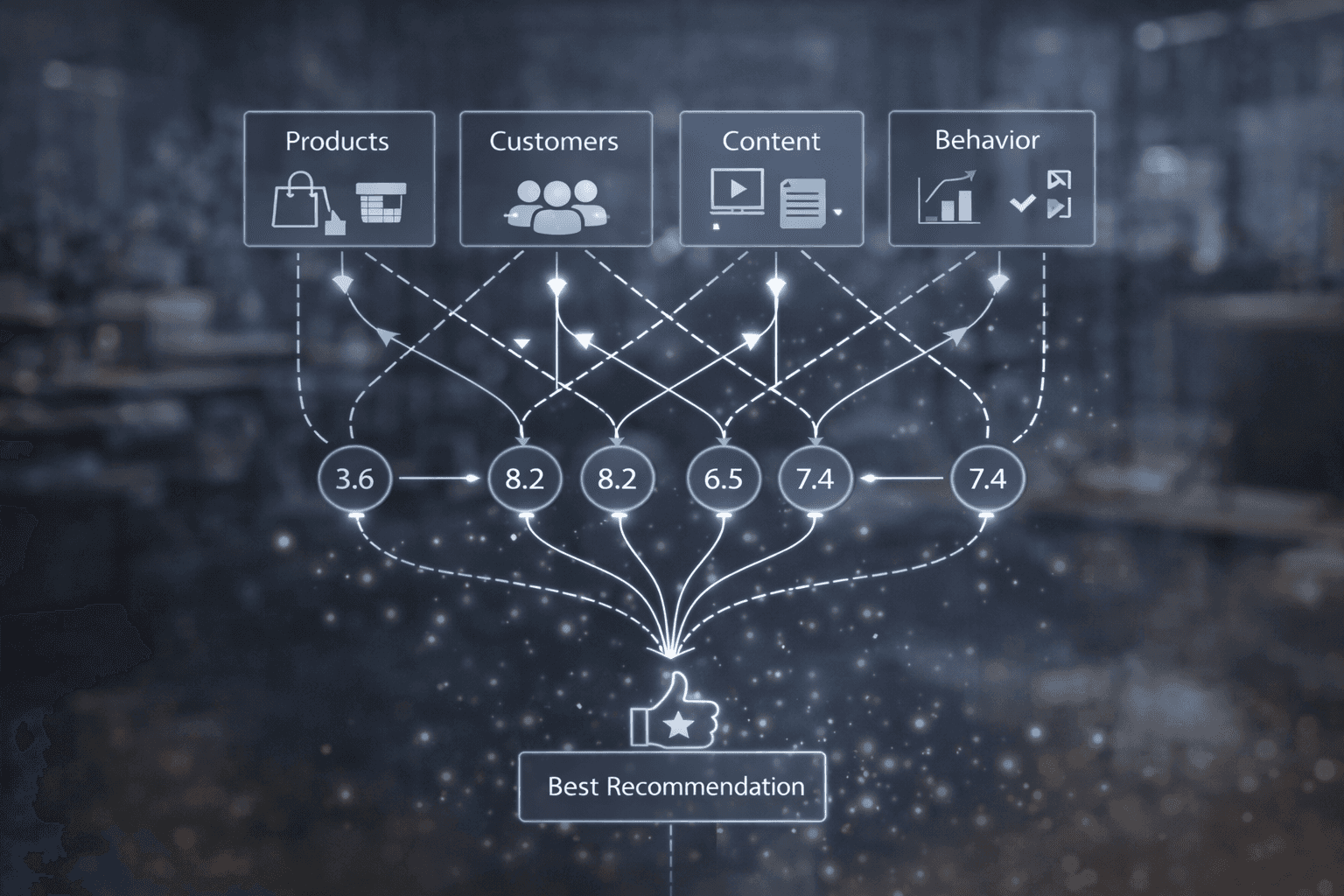
We build recommendation logic and next-best-action views across products, customers, or content using business and behavioral data.
We build recommendation logic and next-best-action views across products, customers, or content using business and behavioral data.
The business increases relevance, improves customer experience, and grows revenue from better actions.
The business increases relevance, improves customer experience, and grows revenue from better actions.
Basket value ↑ • Cross-sell ↑ • Acceptance ↑
Basket value ↑ • Cross-sell ↑ • Acceptance ↑
Recommendation and next-best-action
Problem
Cross-sell, upsell, and recommendation logic is inconsistent, manual, or based on intuition.
What we build
What changes
Mapped solutions
Typical metrics
We build recommendation logic and next-best-action views across products, customers, or content using business and behavioral data.
The business increases relevance, improves customer experience, and grows revenue from better actions.
Basket value ↑ • Cross-sell ↑ • Acceptance ↑

Sales funnel and retention analytics
Sales funnel and retention analytics
Problem
Problem
Pipeline blind spots, churn risk, and inconsistent funnel visibility make growth harder to manage.
Pipeline blind spots, churn risk, and inconsistent funnel visibility make growth harder to manage.
What we build
What we build
What changes
What changes
Mapped solutions
Mapped solutions
Typical metrics
Typical metrics
We build funnel conversion views, retention analysis, segment-level insights, and early-warning signals for leakage and churn.
We build funnel conversion views, retention analysis, segment-level insights, and early-warning signals for leakage and churn.
Commercial teams improve conversion, retain more customers, and act earlier on weak points in the funnel.
Commercial teams improve conversion, retain more customers, and act earlier on weak points in the funnel.
Conversion ↑ • Churn ↓ • Repeat revenue ↑
Conversion ↑ • Churn ↓ • Repeat revenue ↑
Sales funnel and retention analytics
Problem
Pipeline blind spots, churn risk, and inconsistent funnel visibility make growth harder to manage.
What we build
What changes
Mapped solutions
Typical metrics
We build funnel conversion views, retention analysis, segment-level insights, and early-warning signals for leakage and churn.
Commercial teams improve conversion, retain more customers, and act earlier on weak points in the funnel.
Conversion ↑ • Churn ↓ • Repeat revenue ↑
Forecasting and planning
Forecasting and planning
Problem
Problem
Planning is reactive, assumptions age quickly, and the business lacks a structured view of future demand, sales, cash, or operations.
Planning is reactive, assumptions age quickly, and the business lacks a structured view of future demand, sales, cash, or operations.
What we build
What we build
What changes
What changes
Mapped solutions
Mapped solutions
Typical metrics
Typical metrics

We build forecasting models, scenario views, and planning dashboards that turn historical data into earlier signals.
We build forecasting models, scenario views, and planning dashboards that turn historical data into earlier signals.
Teams plan better, respond sooner, and improve working capital, purchasing, and staffing decisions.
Teams plan better, respond sooner, and improve working capital, purchasing, and staffing decisions.
Forecast accuracy ↑ • Planning error ↓ • Stockouts ↓
Forecast accuracy ↑ • Planning error ↓ • Stockouts ↓
Forecasting and planning
Problem
Planning is reactive, assumptions age quickly, and the business lacks a structured view of future demand, sales, cash, or operations.
What we build
What changes
Mapped solutions
Typical metrics
We build forecasting models, scenario views, and planning dashboards that turn historical data into earlier signals.
Teams plan better, respond sooner, and improve working capital, purchasing, and staffing decisions.
Forecast accuracy ↑ • Planning error ↓ • Stockouts ↓

AI governance and AIMS
AI governance and AIMS
Problem
Problem
AI use starts before ownership, approvals, controls, and traceability are in place.
AI use starts before ownership, approvals, controls, and traceability are in place.
What we build
What we build
What changes
What changes
Mapped solutions
Mapped solutions
Typical metrics
Typical metrics

We build ISO 42001-aligned governance structures, roles, controls, evidence logic, and the operating routines needed for safer AI adoption.
We build ISO 42001-aligned governance structures, roles, controls, evidence logic, and the operating routines needed for safer AI adoption.
The organization gains clearer ownership, stronger trust, and a more auditable path to scaling AI.
The organization gains clearer ownership, stronger trust, and a more auditable path to scaling AI.
Governance coverage ↑ • Compliance ↑ • Incidents ↓
Governance coverage ↑ • Compliance ↑ • Incidents ↓
AI governance and AIMS
Problem
AI use starts before ownership, approvals, controls, and traceability are in place.
What we build
What changes
Mapped solutions
Typical metrics
We build ISO 42001-aligned governance structures, roles, controls, evidence logic, and the operating routines needed for safer AI adoption.
The organization gains clearer ownership, stronger trust, and a more auditable path to scaling AI.
Governance coverage ↑ • Compliance ↑ • Incidents ↓

Approvals, controls & audit-ready workflows
Approvals, controls & audit-ready workflows
Problem
Problem
Approvals, policy checks, and audit evidence are spread across emails, shared folders, and manual follow-ups. This slows decisions, creates control gaps, and makes audit readiness harder.
Approvals, policy checks, and audit evidence are spread across emails, shared folders, and manual follow-ups. This slows decisions, creates control gaps, and makes audit readiness harder.
What we build
What we build
What changes
What changes
Mapped solutions
Mapped solutions
Typical metrics
Typical metrics
We build structured approval workflows, control logs, traceable records, and role-based visibility so teams can manage approvals and evidence in a more consistent way.
We build structured approval workflows, control logs, traceable records, and role-based visibility so teams can manage approvals and evidence in a more consistent way.
Teams move faster with clearer ownership, better traceability, and stronger compliance with internal policies and governance requirements.
Teams move faster with clearer ownership, better traceability, and stronger compliance with internal policies and governance requirements.
Approval cycle ↓ • Policy adherence ↑ • Audit readiness ↑
Approval cycle ↓ • Policy adherence ↑ • Audit readiness ↑
Approvals, controls & audit-ready workflows
Problem
Approvals, policy checks, and audit evidence are spread across emails, shared folders, and manual follow-ups. This slows decisions, creates control gaps, and makes audit readiness harder.
What we build
What changes
Mapped solutions
Typical metrics
We build structured approval workflows, control logs, traceable records, and role-based visibility so teams can manage approvals and evidence in a more consistent way.
Teams move faster with clearer ownership, better traceability, and stronger compliance with internal policies and governance requirements.
Approval cycle ↓ • Policy adherence ↑ • Audit readiness ↑

AI copilots for teams
AI copilots for teams
Problem
Problem
Teams lose time searching for information, drafting repeated responses, or navigating internal knowledge and procedures.
Teams lose time searching for information, drafting repeated responses, or navigating internal knowledge and procedures.
What we build
What we build
What changes
What changes
Mapped solutions
Mapped solutions
Typical metrics
Typical metrics
We build secure assistants for internal search, Q&A, summarization, and repetitive team support, with clear scope and review rules.
We build secure assistants for internal search, Q&A, summarization, and repetitive team support, with clear scope and review rules.
Teams save time, respond faster, and use internal knowledge more effectively in daily work.
Teams save time, respond faster, and use internal knowledge more effectively in daily work.
Hours saved ↑ • Response time ↓ • Adoption ↑
Hours saved ↑ • Response time ↓ • Adoption ↑
AI copilots for teams
Problem
Teams lose time searching for information, drafting repeated responses, or navigating internal knowledge and procedures.
What we build
What changes
Mapped solutions
Typical metrics
We build secure assistants for internal search, Q&A, summarization, and repetitive team support, with clear scope and review rules.
Teams save time, respond faster, and use internal knowledge more effectively in daily work.
Hours saved ↑ • Response time ↓ • Adoption ↑
Document intelligence and workflow automation
Document intelligence and workflow automation
Problem
Problem
Important work stays trapped in documents, forms, emails, and repetitive review steps.
Important work stays trapped in documents, forms, emails, and repetitive review steps.
What we build
What we build
What changes
What changes
Mapped solutions
Mapped solutions
Typical metrics
Typical metrics
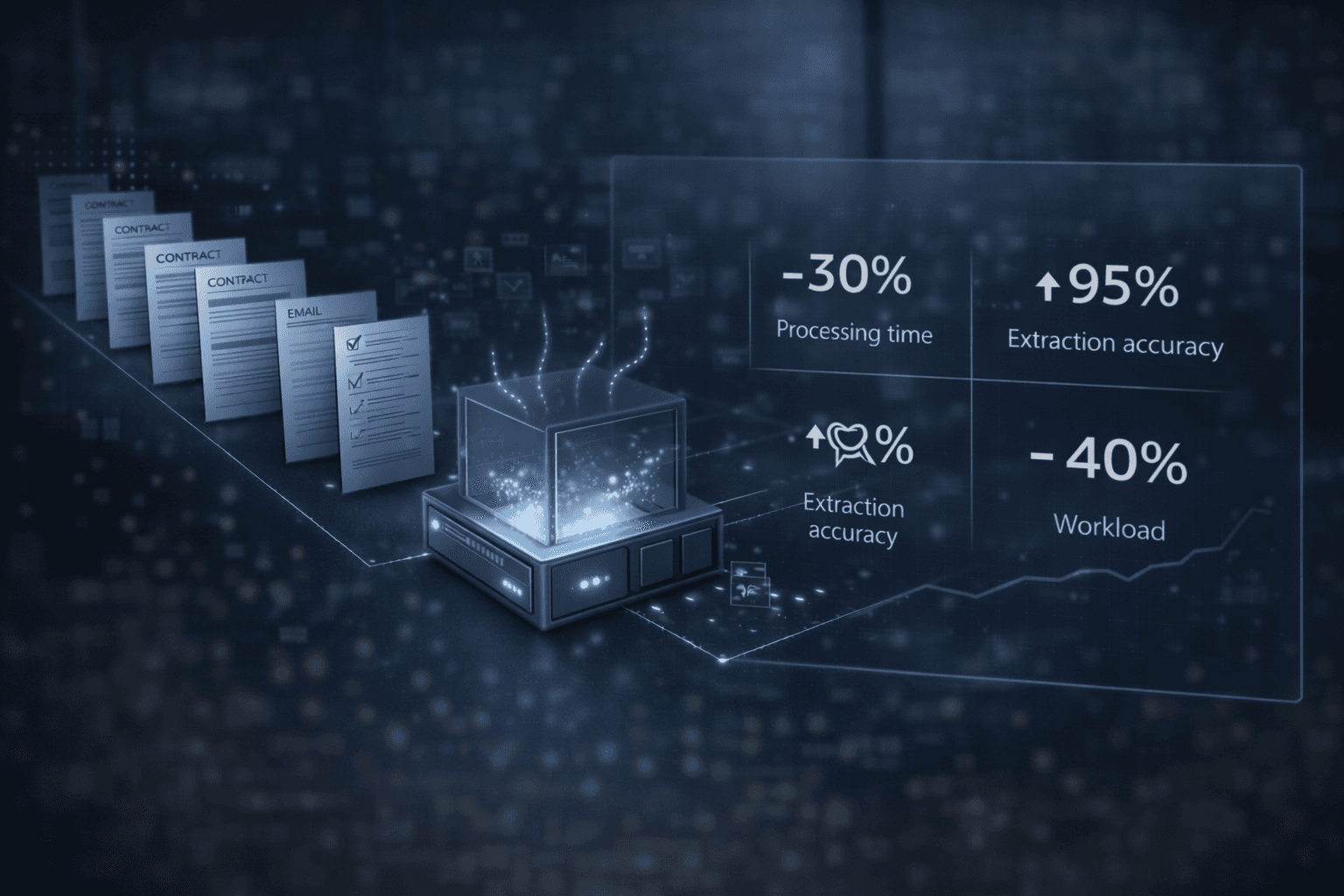
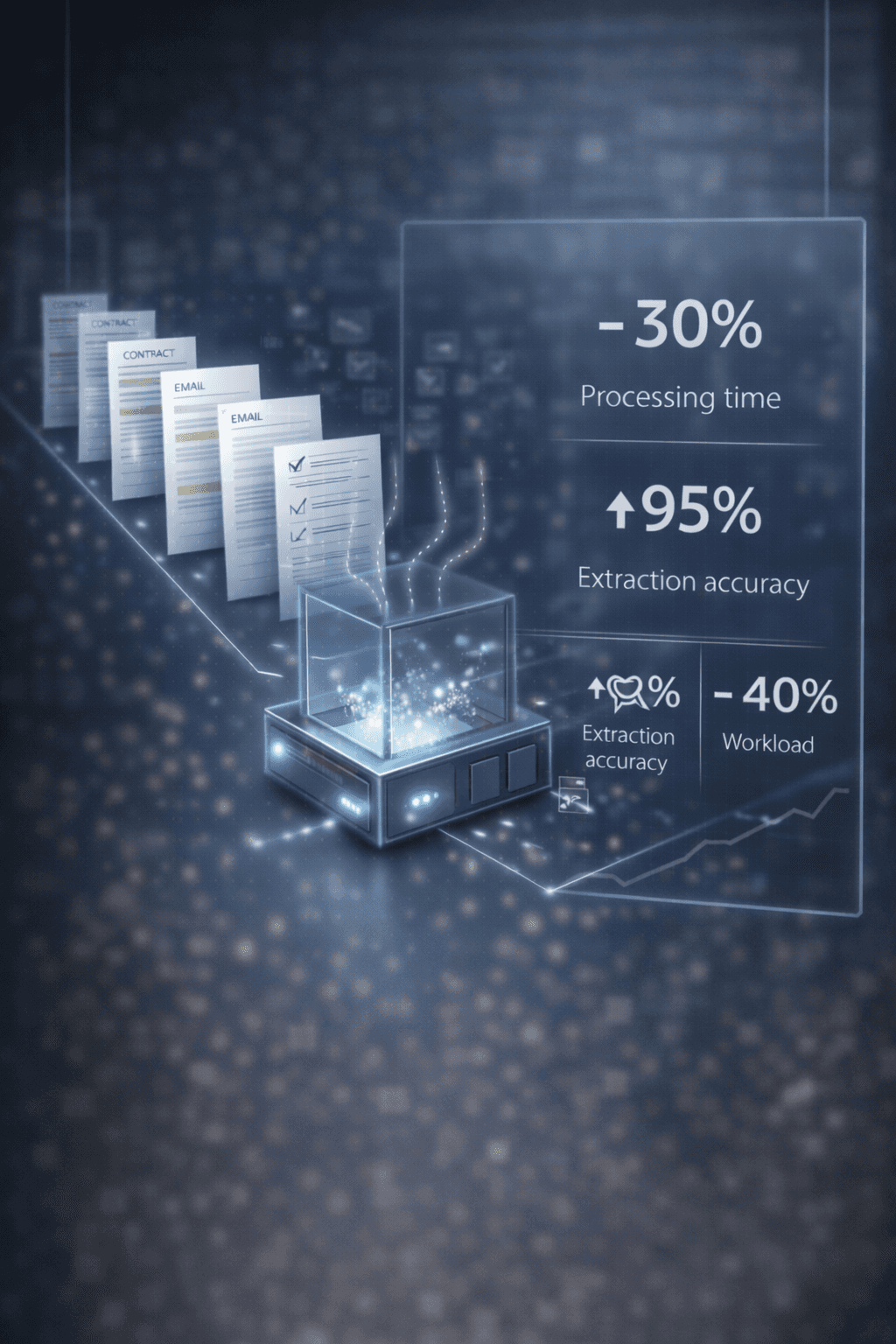
We build extraction, classification, validation, and routing workflows that reduce manual processing and support faster business operations.
We build extraction, classification, validation, and routing workflows that reduce manual processing and support faster business operations.
Back-office work becomes faster, more consistent, and easier to scale.
Back-office work becomes faster, more consistent, and easier to scale.
Processing time ↓ • Extraction accuracy ↑ • Workload ↓
Processing time ↓ • Extraction accuracy ↑ • Workload ↓
Document intelligence and workflow automation
Problem
Important work stays trapped in documents, forms, emails, and repetitive review steps.
What we build
What changes
Mapped solutions
Typical metrics
We build extraction, classification, validation, and routing workflows that reduce manual processing and support faster business operations.
Back-office work becomes faster, more consistent, and easier to scale.
Processing time ↓ • Extraction accuracy ↑ • Workload ↓
Want to discuss a similar use case?
Want to discuss a similar use case?
Tell us what you are trying to improve, and we’ll help you define the right starting point
Tell us what you are trying to improve, and we’ll help you define the right starting point
Contact us
Contact us